Zomato is one of India’s most popular food-delivery platforms. However, it did not begin as a food-delivery company. It initially started as a simple platform that allowed people to find restaurant menus online.
By understanding customer needs, adopting technology and continuously improving its business model, Zomato transformed itself from a small Indian startup into a large publicly listed company.
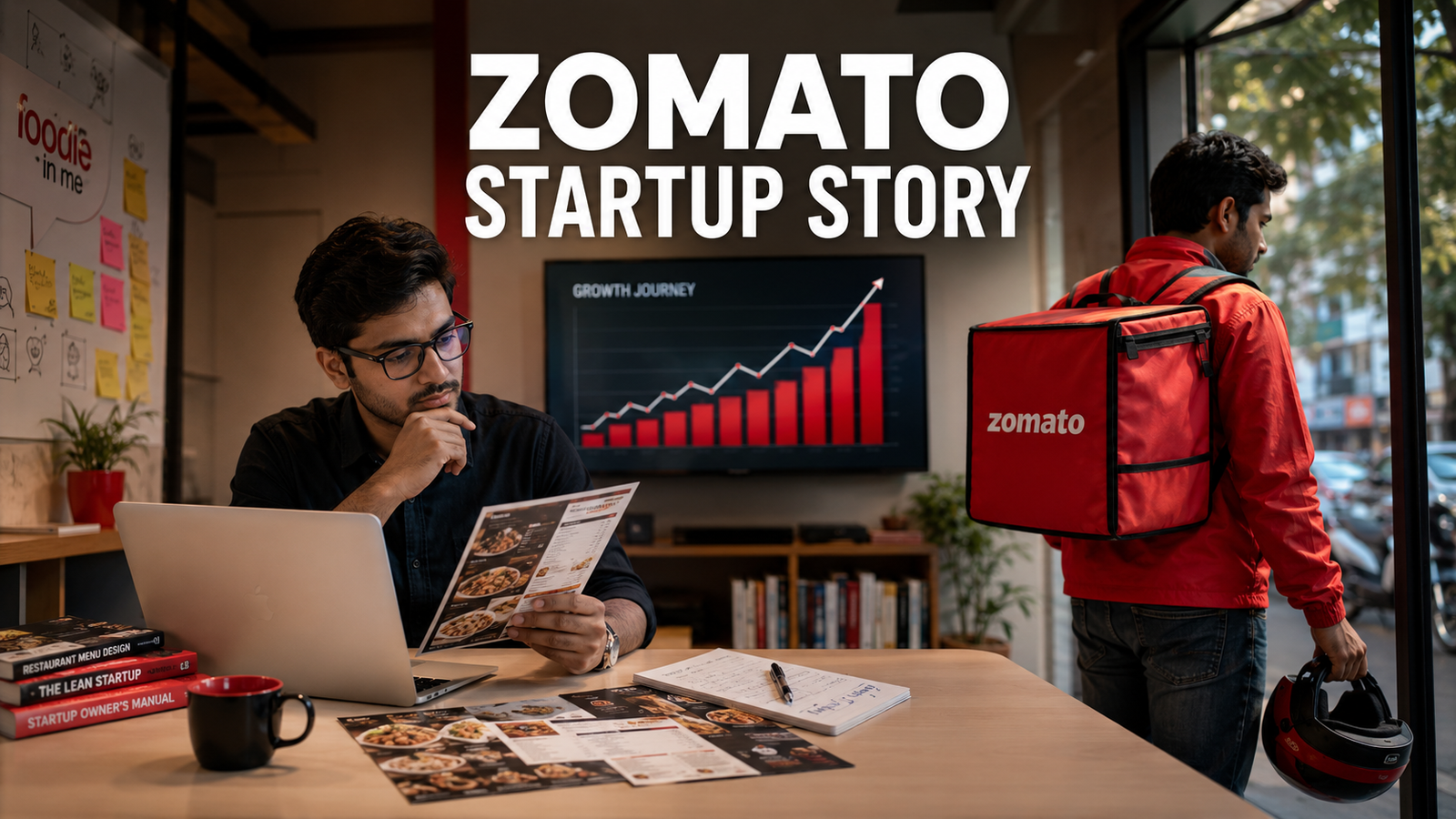
How Did Zomato Start
Zomato was founded in 2008 by Deepinder Goyal and Pankaj Chaddah. At the time, both founders were working at Bain & Company.
Deepinder noticed that employees often had to wait to look through physical restaurant menus before ordering food. To solve this problem, he began scanning restaurant menus and uploading them to an online platform.
This simple idea allowed employees to view menus conveniently and decide what they wanted to order. The platform was initially named Foodiebay.
Foodiebay provided restaurant menus, contact details and other useful information. As more restaurants were added, the platform gradually attracted a larger number of users.
Why Was Foodiebay Renamed Zomato
In 2010, Foodiebay was renamed Zomato. One reason behind the decision was to avoid a possible trademark conflict with eBay.
The founders also wanted a unique and memorable name that would not restrict the business to restaurant listings. The name “Zomato” was short, brandable and suitable for the company’s long-term expansion plans.
Following the rebranding, Zomato expanded its restaurant-discovery services to several Indian cities.
What Was Zomato’s Initial Business Model
Zomato initially operated as a restaurant discovery and information platform. Users could find restaurant menus, locations, contact details, ratings and customer reviews for free.
The company earned revenue primarily through advertising and promoted restaurant listings. Restaurants paid Zomato to gain greater visibility and reach more potential customers.
This business model became more valuable as Zomato’s user base increased. Restaurants were willing to advertise because the platform could connect them with people actively searching for dining options.
Zomato’s Entry into the Food-Delivery Market
The growing use of smartphones, internet services and digital payments created a major opportunity in India’s online food-delivery market.
Zomato entered the food-delivery business in 2015. Initially, it worked with third-party logistics providers to deliver orders from restaurants. The company later developed its own large network of delivery partners.
Customers could now use Zomato to discover restaurants, place orders, make online payments and track their deliveries. This transformation turned Zomato from a restaurant-listing website into a complete food-tech platform.
How Does Zomato Make Money
Zomato earns money through multiple revenue sources. One of its primary sources is the commission restaurants pay on orders placed through the platform.
It also generates revenue through delivery charges, platform fees, restaurant advertisements, promoted listings and membership programmes such as Zomato Gold.
The Hyperpure business supplies vegetables, groceries, meat, packaging materials and other essential items to restaurants.
Blinkit generates revenue by offering rapid delivery of groceries and everyday products. District focuses on dining, movies, events and other going-out experiences.
Acquisition of Uber Eats India
In January 2020, Zomato acquired Uber Eats’ Indian operations through an all-stock transaction. Following the acquisition, Uber Eats discontinued its independent operations in India, and its customers and restaurant partners were moved to Zomato.
The acquisition helped Zomato expand its customer base, strengthen its restaurant network and improve its position in the highly competitive Indian food-delivery market.
Zomato’s IPO Journey
Zomato launched its Initial Public Offering in July 2021. Its IPO price was fixed at ₹76 per share and received significant interest from investors.
The company made a strong debut on the stock market. Zomato’s IPO became an important milestone for India’s startup ecosystem because it demonstrated that a large internet-based Indian startup could successfully enter the public market.
It also encouraged several other Indian startups to consider public listings.
Zomato’s Acquisition of Blinkit
In 2022, Zomato completed the acquisition of quick-commerce company Blinkit, which was previously known as Grofers.
The acquisition allowed Zomato to expand beyond restaurant food delivery and enter the rapidly growing market for quick delivery of groceries and everyday products.
Blinkit initially required substantial investment to expand its dark-store and delivery network. However, rising demand for quick commerce eventually turned it into one of Eternal’s most important growth businesses.
Why Did Zomato Limited Become Eternal Limited
During the 2024–25 financial year, the listed parent company changed its name from Zomato Limited to Eternal Limited. However, the food-delivery application continues to operate under the Zomato brand.
Eternal Limited now manages four major businesses: Zomato, Blinkit, District and Hyperpure. The name change reflects the fact that the parent company is no longer limited to food delivery. Learn more about Eternal’s businesses
Zomato’s Financial Performance
The figures below represent the consolidated financial performance of the entire parent company, Eternal Limited. Therefore, they include Zomato food delivery, Blinkit, Hyperpure and District.
| Financial Year | Revenue from Operations | Net Profit | Revenue Growth | Financial Status |
|---|---|---|---|---|
| FY 2022–23 | ₹7,079 crore | ₹971 crore loss | — | Loss-making |
| FY 2023–24 | ₹12,114 crore | ₹351 crore profit | 71% | Became profitable |
| FY 2024–25 | ₹20,243 crore | ₹527 crore profit | 67% | Profitable |
| Q1 FY 2026–27 | ₹20,648 crore adjusted revenue | Not directly comparable | 66% like-for-like | Strong growth |
Note: These are consolidated figures for Eternal Limited, Zomato’s parent company. They include Zomato, Blinkit, Hyperpure and District. The Q1 FY 2026–27 figure is adjusted revenue, so it should not be directly compared with statutory annual revenue.
Latest Operational Financial Metrics
| Reporting Period | Adjusted Revenue | Adjusted EBITDA | B2C Net Order Value | Year-on-Year Growth |
|---|---|---|---|---|
| Q4 FY 2025–26 | ₹17,680 crore | ₹429 crore | ₹26,880 crore | 64% like-for-like |
| Q1 FY 2026–27 | ₹20,648 crore | ₹555 crore | ₹31,120 crore | 66% like-for-like |
Eternal Limited’s revenue from operations increased from ₹12,114 crore in FY 2023–24 to ₹20,243 crore in FY 2024–25. Its consolidated net profit also increased from approximately ₹351 crore to ₹527 crore.
These results demonstrate the company’s progress towards building a profitable business after spending several years investing heavily in growth, technology, customer acquisition and delivery infrastructure. View the FY25 Annual Report
Zomato’s Latest Financial Growth
In the April–June 2026 quarter, which was Q1 FY2026–27, Eternal reported consolidated adjusted revenue of ₹20,648 crore. This represented year-on-year growth of 173%, while growth on a like-for-like basis was 66%.
Consolidated adjusted EBITDA reached ₹555 crore, representing annual growth of 223%. The company’s B2C Net Order Value reached ₹31,120 crore during the quarter.
Adjusted revenue and adjusted EBITDA are management-defined operational measurements. Therefore, they should not be treated as being identical to statutory revenue and net profit. View Eternal’s Q1 FY27 results
Major Challenges Faced by Zomato
Zomato’s journey was not easy. The company faced intense competition, high delivery expenses, customer discounting, operational complexity and several years of financial losses.
It also encountered difficulties while expanding internationally. Zomato eventually exited several overseas markets and adopted a more focused India-centred strategy.
In the food-delivery market, it had to compete with companies such as Swiggy. Zomato also needed to balance the interests of customers, restaurants and delivery partners while attempting to improve profitability.
The company gradually reduced its dependence on excessive discounts, improved delivery operations and focused on businesses with stronger long-term growth potential.
Key Reasons Behind Zomato’s Success
Zomato’s success began with identifying a genuine customer problem. The company started by making restaurant menus easily accessible and subsequently expanded its services according to changing customer needs.
Its investment in technology, strong brand identity and willingness to adapt its business model played major roles in its growth.
Strategic acquisitions such as Uber Eats India and Blinkit also strengthened the company’s position. Zomato successfully expanded from restaurant discovery into food delivery, restaurant supplies, quick commerce and going-out experiences.
What Can Entrepreneurs Learn from Zomato?
Zomato’s story shows that entrepreneurs do not always need a revolutionary idea to start a successful business. Solving a common everyday problem effectively can also become the foundation of a large company.
Entrepreneurs must understand their customers, monitor changes in the market and remain willing to improve their products. They should also learn from failed experiments instead of allowing those failures to stop future progress.
Rapid growth alone cannot guarantee long-term success. A sustainable business must balance revenue growth, operating costs, customer experience and profitability.